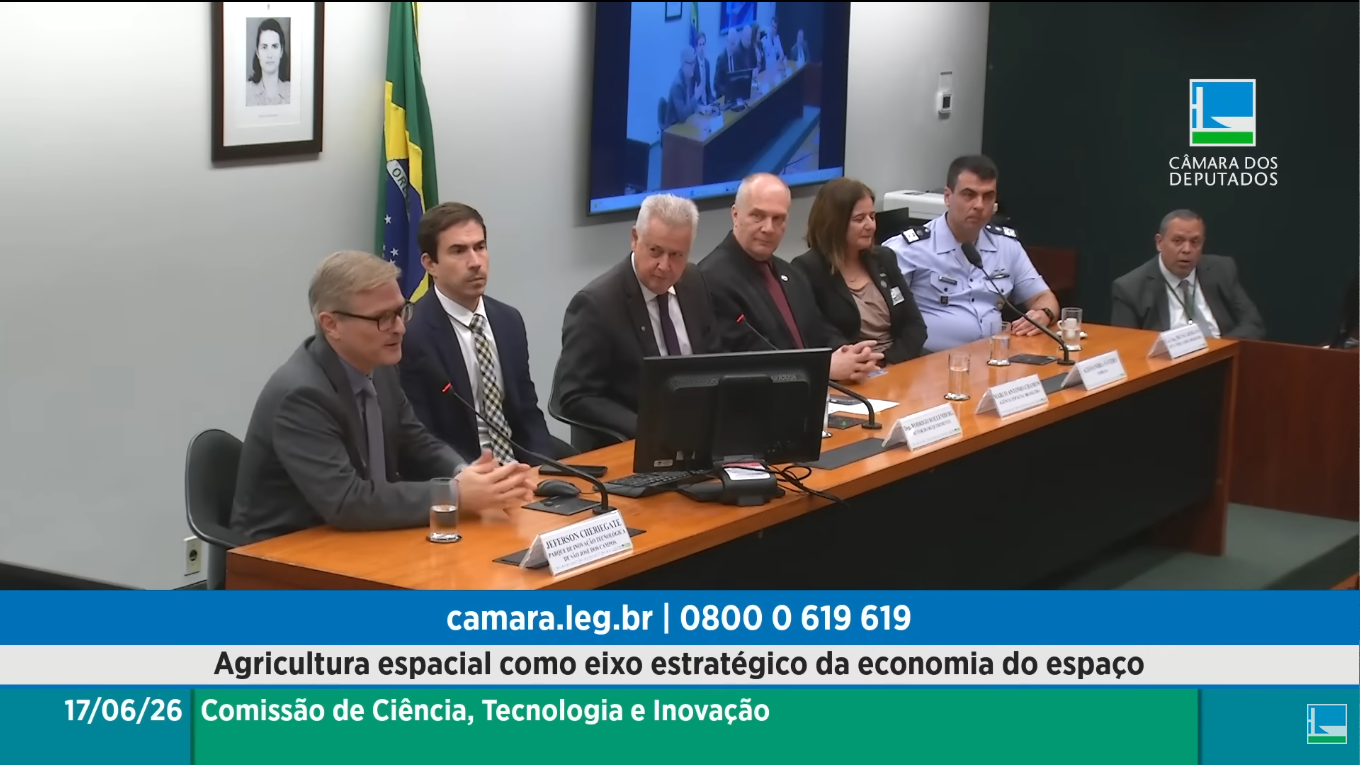
A public hearing held by the Chamber of Deputies' Committee on Science, Technology, and Innovation discussed space agriculture as a strategic frontier for Brazil, highlighting the central role of the Space Farming Brazil Network in coordinating these efforts. The meeting underscored the country's potential to extend its global leadership in tropical agriculture into the cosmos, aiming not only to support lunar and interplanetary missions under the Artemis Accords but also to develop resilient technologies to address climate change on Earth.
 Figura 1. Rede Space Farming Brazil. Fonte: Transmissão da Câmara dos Deputados - Online, 2026
The discussion was grounded in Brazil's accession to the Artemis Accords in 2021, which envision the peaceful exploration of the Moon and the establishment of permanent human bases starting in 2030. In this context, in situ food production becomes vital, and Brazil seeks to position itself as a key hub for these international discussions.
A audiência contou com contribuições de especialistas, que destacaram as várias facetas do tema:
Marco Antônio Chamon (President of the Brazilian Space Agency – AEB)
 Figure 2. Marco Antônio Chamon, President of the Brazilian Space Agency. Source: Chamber of Deputies online broadcast, 2026.
Chamon contextualized space agriculture within the scope of future lunar exploration, highlighting that a human presence in space will require autonomous supplies of water, oxygen, and food. He emphasized that the partnership with Embrapa represents a competitive advantage for Brazil, given the organization's global reputation in agricultural science. The AEB is coordinating a Brazilian space agriculture network—already comprising over 20 national and international institutions—aimed at generating significant scientific contributions to the Artemis program.
Alessandra Pereira Fávero (Embrapa Researcher and Coordinator of the Space Farming Brazil Network)
 Figure 3. Alessandra Pereira Fávero, Embrapa researcher and coordinator of the Space Farming Brazil Network. Source: Chamber of Deputies online broadcast, 2026.
Alessandra presented the concept of growing plants in space as essential for human survival at permanent bases. She detailed experiments already conducted with sweet potatoes and chickpeas, including seeds that orbited Earth for seven days aboard the International Space Station (ISS). The researcher highlighted that the extreme environment of space generates valuable technological spin-offs for farmers on Earth, such as advances in vertical farming, LED lighting, robotics, and automation, that help mitigate climate change and ensure food security in remote regions.
Jeferson Cheriegate (President of the São José dos Campos Technology Innovation Park – PIT)
 Figure 4. Jeferson Cheriegate, President of the São José dos Campos Technology Innovation Park (PIT). Source: Chamber of Deputies online broadcast, 2026.
Cheriegate highlighted the PIT's role as an innovation hub, concentrating 95% of Brazil's space development activities. He argued that while space colonization is the ultimate goal, the real economic value lies in the technological knowledge gained along the way, which enhances the profitability of the national agribusiness sector. Cheriegate announced the creation of a space agriculture laboratory at the PIT to certify instruments and support startups, emphasizing that production in space demands a level of energy and resource efficiency that will transform both family and industrial agriculture on Earth.
Colonel (Engineer) Bruno Giordano (Director of the Institute for Advanced Studies – IEAv/DCTA)
 Figure 5. Engineer Colonel Bruno Giordano, Director of the Institute for Advanced Studies (IEAv/DCTA). Source: Chamber of Deputies online broadcast, 2026.
Representing the aerospace defense and technology sector, Giordano focused on the physical challenges of space: microgravity and ionizing radiation. The DCTA contributes by conducting dosimetry tests and simulating these extreme environments to study mutations in seeds and microorganisms. He highlighted the Potiguá Mission, scheduled for September 2026. A practical example cited was the use of radiation to develop grass varieties that produce fewer seeds, thereby reducing the risk of bird strikes at airfields.
Rafael Loureiro (Professor at Winston-Salem State University)
 Figure 6. Rafael Loureiro, Professor at Winston-Salem State University. Source: Chamber of Deputies online broadcast, 2026.
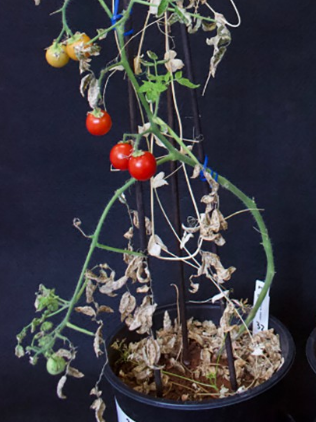
Participating virtually, Loureiro, who collaborates directly with NASA, emphasized that space agriculture should be treated as a matter of public policy. He showcased research on growing tomatoes in lunar regolith using microbiome engineering to ensure food self-sufficiency beyond Earth. Loureiro proposed establishing a national program with predictable funding and a focus on developing Brazilian talent, enabling the country not only to participate in but to lead food production in resource-constrained environments.
The debate emphasized that Brazil, as a global benchmark in tropical agriculture, possesses a unique competitive advantage to lead this sector within the new space economy.
Below, we detail the key perspectives presented:
1. Sovereignty and International Alliances: AEB President Marco Antônio Chamon explained that Brazil's accession to the Artemis Accords in 2021 positions the country at the forefront of lunar exploration. He highlighted that permanent bases on the Moon, slated for 2030, will require autonomy regarding oxygen, water, and food, making the partnership between the AEB and Embrapa a strategic asset for the international program.
2. Economic Development and Startups: Jeferson Cheriegate, of PIT São José dos Campos, argued that the real economic value lies in the technological knowledge acquired, while colonization is merely the cherry on top. He announced the creation of a space agriculture laboratory at PIT to certify instruments and boost Brazilian startups at the forefront of agribusiness.
3. Extreme Environments and Defense: Colonel Bruno Giordano (DCTA) detailed how defense laboratories are used to simulate ionizing radiation and microgravity. Experiments have shown that radiation can induce beneficial mutations, such as in grasses that produce fewer seeds, thereby reducing the risk of bird strikes at airfields. He also mentioned the Potiguá Mission, which will carry plant growth-promoting microorganisms into space.
4. Microbiome Science and Public Policy: Professor Rafael Loureiro presented results from growing tomatoes in lunar regolith (a lunar soil analogue) using microbiome engineering. He proposed establishing space agriculture as a national public policy, featuring predictable funding and a focus on training new Brazilian talent in partnership with international institutions.
The event concluded with a parliamentary commitment to allocate more resources to the sector, recognizing that investment in space science is, fundamentally, an investment in the country's sustainability and future.